



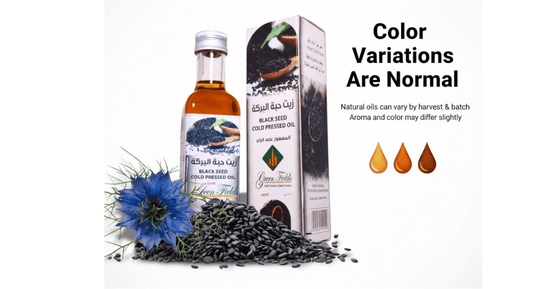
I get this question almost every day. Someone holds up a bottle and asks: "Is this real? How can I tell?"
I understand the confusion. I've been there myself. In fact, that confusion is exactly why I started Green Fields Oils twenty years ago. I was searching for pure black seed oil for my son, and everything I found was wrong. Not a little wrong. Completely wrong.
So let me share what twenty years of making oil has taught me. Not what the marketing says. Not what the labels claim. What I've learned by actually pressing seeds, watching the oil flow, and testing batch after batch.
What Color Should It Be?
Here's the first thing most people get wrong: black seed oil is not black.
I know, the name is confusing. The seed itself is black on the outside—small, triangular, with that distinctive shape. But inside? The seed is white. Just like an olive. Olives can be black or green on the outside, but the oil inside is always some shade of yellow or gold.
Real black seed oil ranges from yellow to deep amber to orange-brown. It varies naturally.
If your oil is black, I'm sorry, but that's probably dye. Someone colored it to make you think it's stronger or more "real." It's not.
The Smell and Taste Change—And That's Normal
People often write to me worried: "I bought your oil and it tastes different from last time. Is something wrong?"
Nothing is wrong. You're just tasting nature.
Black seed oil comes from a crop. And like any crop—olives, grapes, wheat—it changes. The soil that season. The rainfall. The harvest time. Even the specific variety of seed. All of it affects the smell and taste.
Sometimes you'll get a batch that hits the back of your throat with a strong kick. Sometimes it's milder, more gentle. Neither one means it's fake or weak. It just means it's real.
The only way to truly know what's in the bottle is lab testing. Everything else is just educated guessing.
What About Thickness and Texture?
Black seed oil is an oil. It should feel like one.
If your oil is thick—almost syrupy or gel-like—something else is in that bottle. Sometimes it's propylene glycol or another thickener added to mimic the texture of real oil. Real oil flows. It coats a spoon, but it doesn't sit there like honey.
If your oil has sediment at the bottom, that doesn't mean it's impure. It usually means the manufacturer bottled it too quickly instead of waiting for it to clear naturally. It's not harmful, but it tells you something about how carefully they made it.
The Label Means Almost Nothing
This is the part that frustrates me most.
The market for "novel foods" and natural products is not well regulated when it comes to labels. Anyone can print "cold pressed" on a bottle. Anyone can write "contains thymoquinone" or "100% pure." There's no one checking before it hits the shelf.
I've seen cheap, diluted oils with beautiful labels. I've seen excellent oils with plain, simple packaging. The label tells you what they want you to believe. It doesn't tell you what's inside.
The Heat Test (But Please Don't Do This With Your Oil)
Here's something I know from making oil: real black seed oil should never be heated during processing.
Why? Because black seed contains naturally occurring essential oils. Heat destroys them. If a manufacturer heats the oil to extract more volume or speed up production, they're killing the very thing you bought it for.
This is why "cold pressed" matters—but only if it's true. And you can't tell from the label.
So How Do You Really Know?
After twenty years, here's my honest answer:
You can look. You can smell. You can taste. You can shake the bottle and watch how it moves. All of these give you clues.
But the only real way to know? Buy from someone you trust.
Someone who:
-
Has been doing this long enough that reputation matters
-
Can tell you where the seeds come from
-
Doesn't mind questions
-
Tests their oil and can show you the results
I don't say that because I want your business (though of course I do). I say it because it's the truth. After two decades, I've learned that purity isn't something you can put on a label. It's something you build into every batch, every decision, every relationship with the farmers who grow the seeds.
Still Unsure?
If you have a bottle at home and you're wondering whether it's real, here's what I'll offer you:
Take a photo. Hold it up to the light. Send it to me.
I'll tell you honestly what I see. No sales pitch. Just twenty years of looking at oil.
Because that's how this started—with me standing in a market, holding bottle after bottle, wondering if any of them were real. I know what that feels like. And if I can help you find what you're looking for, that's enough.
Amina Al Ramadna
Founder, Green Fields Oils
Twenty years of pressing seeds, asking questions, and trying to get it right.




Validate your login