



Introduction
Pistacia atlantica (Atlas pistachio) is a wild tree native to the Middle East and North Africa. For centuries, its fruits, resin, and oil have been used in traditional practices. In recent years, researchers have begun to investigate its chemical composition and potential applications in food, cosmetics, and wellness.
This post summarises peer‑reviewed studies on cold‑pressed P. atlantica seed oil. The information is for educational purposes only and is not intended as medical advice.
Chemical Composition
The fatty acid profile of P. atlantica seed oil has been analysed in multiple studies. The results confirm that it is an unsaturated fatty acid‑rich oil, with unsaturated fats accounting for approximately 74–78% of total fatty acids.
| Fatty Acid | Typical Percentage |
|---|---|
| Linoleic acid (omega‑6) | 19–31% |
| Oleic acid (omega‑9) | 12–49% |
| Palmitic acid | 6–26% |
| Stearic acid | 2–3% |
| Linolenic acid (omega‑3) | 1–1.5% |
Sources:
The oil also contains natural antioxidants, including tocopherols (vitamin E), sterols, and phenolic compounds. GC‑MS analysis has identified up to 37 lipophilic components in the fruit oil, with palmitic acid as a major constituent (up to ~55%).
Antioxidant Activity
Several studies have confirmed the antioxidant potential of P. atlantica oil. One study evaluated the oil's ability to scavenge free radicals and found that at a concentration of 400 µl/ml, its antioxidant efficacy reached 91.37% (comparable to ascorbic acid).
Another comparative study on P. atlantica and P. khinjuk oils confirmed that both species are rich in phenolic compounds and exhibit high antioxidant properties.
The antioxidant activity is attributed to the oil's high content of unsaturated fatty acids, tocopherols, and phenolic compounds. These compounds help protect cells from oxidative stress by neutralising free radicals.
Anti‑Inflammatory and Other Biological Properties
Research has explored several biological activities of P. atlantica oil and extracts.
-
Anti‑inflammatory activity: A 2024 study on Tunisian vegetable oils found that P. atlantica oil showed significant inhibitory activity against inflammatory enzymes, comparable to other well‑known oils.
-
Antimicrobial activity: The essential oil from P. atlantica leaves has demonstrated activity against Staphylococcus aureus, Escherichia coli, and Candida albicans. The oil extracted from P. atlantica hulls showed significant antibacterial effects with MIC values of 6 µg/ml (S. aureus) and 12.5 µg/ml (E. coli).
-
Antioxidant and biocompatibility for skin care: A 2024 study developed a novel nanofiber system encapsulating P. atlantica oil. The oil‑loaded nanoparticles demonstrated robust antioxidant activity and excellent biocompatibility (maintaining over 82% cell viability in human skin cells), suggesting potential for wound healing and skincare formulations.
-
Gastroprotective potential: Studies on P. atlantica oleoresin gum have shown gastroprotective effects in animal models, including restoration of antioxidant enzyme levels and reduction of inflammatory markers.
Traditional and Cosmetic Uses
A 2022 review highlighted that Atlas pistachio fixed oil has been traditionally incorporated into soaps, creams, and shampoos. The oil's unsaturated fatty acids (oleic, linoleic, palmitic, stearic) and sterols provide emollient and moisturising properties, making it suitable for cosmetic formulations.
The oil's high unsaturated fatty acid content and natural antioxidants make it a valuable ingredient for skincare products, where it can help maintain skin hydration and protect against environmental stressors.
Summary of Research Findings
| Property / Activity | Key Finding |
|---|---|
| Fatty acid profile | High in unsaturated fats (74–78%); rich in linoleic and oleic acids |
| Antioxidant activity | Strong free‑radical scavenging; efficacy up to 91% at 400 µl/ml |
| Anti‑inflammatory activity | Significant inhibition of inflammatory enzymes |
| Antimicrobial activity | Effective against S. aureus, E. coli, and C. albicans |
| Skin care potential | Biocompatible; supports wound healing formulations |
| Cosmetic applications | Traditionally used in soaps, creams, and shampoos |
How This Relates to Our Oil
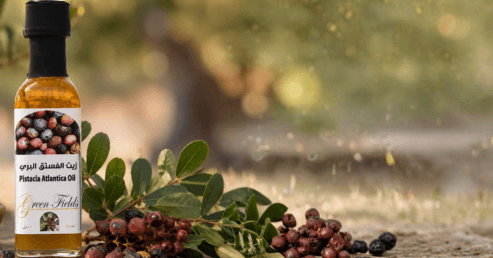
At Green Fields Oils, our cold‑pressed Pistacia atlantica seed oil is extracted using mechanical pressing – no heat, no solvents – to preserve its natural fatty acid profile and antioxidant content. The seeds are sourced directly from family farmers in Jerash, Jordan.
Our oil is available for:
-
Retail – 40 ml amber glass bottle
-
Wholesale (B2B) – Bulk quantities for manufacturers, formulators, and brands
References (Selected Studies)
-
Mohsen SS. (2025). The Effect of Oil Extracted from Pistacia Atlantica on the Qualitative Characteristics of Laboratory Biscuits. IOP Conference Series.
-
Hazrati S, Govahi M, et al. Comparison and Evaluation of Oil Content, Composition and Antioxidant Properties of Pistacia atlantica and Pistacia khinjuk.
-
Belyagoubi‑Benhammou N, et al. (2024). Nutraceutical Content and Biological Properties of Lipophilic and Hydrophilic Fractions of the Phytocomplex from Pistacia atlantica Desf. Buds, Roots, and Fruits. Plants.
-
El Zerey‑Belaskri A, et al. (2022). From Traditional Knowledge to Modern Formulation: Potential and Prospects of Pistacia atlantica Desf. Essential and Fixed Oils Uses in Cosmetics. Cosmetics.
-
Bassouya M, et al. (2025). Chemical, Mineralogical, and Biological Properties of Pistacia atlantica subsp. atlantica Essential Oils from the Middle Atlas of Morocco. Horticulturae.
-
Ghotbi Maleki V, et al. (2024). Fabrication of Pistacia atlantica Oil‑Encapsulated Chitosan Nanoparticles in Polyvinyl Alcohol Nanofibers: Biocompatibility and Antioxidant Properties for Skin Care Applications.
-
Tlili H, et al. (2025). HPLC‑ESI/MS‑Based Polyphenolic Profiling and Bioactivities of Pistacia atlantica. Chemistry & Biodiversity.
-
Nature Index. Antioxidant Activity and Therapeutic Applications of Pistacia Species (2025).
Disclaimer: The information provided in this article is based on published scientific research and is for educational purposes only. It does not constitute medical advice. Green Fields Oils does not claim that our products diagnose, treat, cure, or prevent any disease. Always consult a qualified healthcare professional before using any product.




Validate your login