



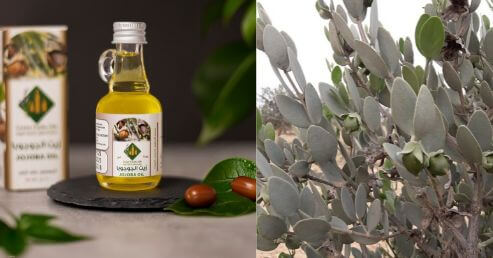
Most people call it an oil. It isn't. And once you understand what it really is, you'll never look at a bottle the same way again.
It Started as a Science Project
Jojoba didn't arrive in Jordan through commerce. It arrived through curiosity.
In the north of the country, a university planted the first jojoba as a research project. It was experimental — no one knew if it would survive, let alone thrive. But it did. The plant is native to desert conditions, and northern Jordan gave it exactly what it needed.
Then something unexpected happened. Farmers started experimenting on their own.
They saw how little water the plant needed. They saw the price the oil could fetch. They started planting small plots, then bigger ones. Within a few years, jojoba had moved from a university trial to a real crop — grown by families, not corporations.
That is how jojoba came to Jordan. Not by plan. By people paying attention.
The First Thing You Need to Know: Jojoba Is Not an Oil
This is the fact that surprises almost everyone.
Jojoba is a wax, not an oil.
Technically, it's a liquid wax ester. That's why it behaves so differently from every other oil on the shelf — and it's why it works so well on skin.
Here's why that matters:
-
It doesn't go rancid easily like most oils do.
-
It closely mimics human sebum — the natural oil your skin produces.
-
It absorbs without clogging pores.
Because it is a wax, it doesn't feed bacteria the way some oils can. This is one of the reasons it works so beautifully for sensitive skin.
But this same property creates a problem in winter that I still remember clearly.
The Winter I'll Never Forget
In the early days of the factory, we had a serious problem every winter.
The jojoba would solidify.
Jojoba wax has a high melting point. When the temperature drops, it doesn't stay liquid — it turns into a thick, cloudy, semi-solid mass. And when that happened, we simply could not fill orders.
I remember standing in the factory in the cold, looking at drums of wax that should have been pourable, and thinking: how do I explain this to a customer who is waiting?
The first few winters, we lost orders. Not because the product was bad — because we hadn't understood what we were working with.
Eventually, we solved it. We learned how to store it, how to warm it gently before filling, how to time production around the seasons. But that first winter taught me something important: you cannot treat jojoba like an ordinary oil.
Every supplier who has never worked with jojoba directly will eventually run into this problem. We solved it 20 years ago.
The Diaper Cream Discovery
Here is the story I tell most often.
When my children were babies, I dealt with every parent's challenge: diaper rash. Like most mothers, I tried the creams. Some worked a little. Some didn't.
Then, out of curiosity more than anything else, I tried pure jojoba wax on my own children.
I am careful about claims. I don't sell miracle products. But I will tell you honestly what I saw:
It worked better than every diaper cream I had ever bought.
The rash calmed. The skin healed. And unlike heavy creams, it didn't leave a thick residue.
This wasn't a marketing discovery — it was a mother's discovery. And it is still one of the reasons I trust the product so deeply. When you have used something on your own children, you stop thinking of it as a product. You think of it as something you can stand behind.
Today, our jojoba is the same wax I used on my children. Nothing about that has changed.
The First Big Order: 40 Square Meters and South Korea
People ask me how Green Fields grew. I always give the same honest answer: we grew one order at a time.
In the very early days, our factory was only 40 square meters. That's smaller than most living rooms. We had one machine, one small space, and a lot of belief.
Then one day, an order came in from South Korea. It was a large quantity — far larger than anything we had handled before.
We had almost no capacity to produce it. But we had something more valuable: the willingness to figure it out.
We produced it. We shipped it. And that one order taught me more than any business course ever could.
It also proved something I already suspected: there was a global market for pure Jordanian jojoba. People would pay for the real thing. They just needed to find it.
The Lesson I Keep Coming Back To
Through all of this — the university project, the solidified wax, the diaper cream, the South Korean order — one lesson stood out.
Farmers should work together, not compete.
I saw early on what happens when growers compete on price instead of quality. The market gets flooded with cheap oil. Quality drops. Buyers stop trusting the source.
But when farmers cooperate — sharing knowledge, sharing equipment, sharing the risk — everyone succeeds.
That is how we have built our supply chain. We work directly with farmers who care about the plant, not just the profit. We pay fairly. We stay loyal year after year. And in return, we get a quality of jojoba that no mass producer can match.
What You'll Find in the Market Today
This is the part of the story that bothers me.
Many products sold as "jojoba oil" are perfumed oils or diluted mixtures. Some of them smell "nice" — but jojoba has almost no smell. If you open a bottle of jojoba and it hits you with a strong fragrance, something is not right.
Real jojoba is:
-
Golden to pale yellow in colour
-
Nearly odourless
-
Light, waxy, and smooth — not greasy
-
Solid or cloudy in cold temperatures (this is normal)
The "gold jojoba" I know — the one we have been producing for 20 years — looks and behaves like that. It doesn't need perfume. It doesn't need clever branding. It works because it is real.
Why Jojoba Works So Well on Skin
Because jojoba is a wax that mimics your skin's natural sebum, it does things most oils cannot:
-
Balances oily skin instead of adding to it
-
Moisturises dry skin without a heavy film
-
Calms irritated skin without stinging
-
Absorbs cleanly and leaves no residue
-
Stays stable far longer than regular oils
It is one of the rare ingredients that works across every skin type — which is why you'll find it in premium skincare all over the world.
Why Our Jojoba Is Different
We have been working with jojoba since before it was fashionable. Twenty years of experience, in the same country, with the same farmers, has taught us things you cannot learn from a manual.
Here is what that means for you:
-
We press the wax ourselves — we are not a reseller.
-
We source from Jordanian farmers we know personally.
-
We do not add fragrance, fillers, or preservatives.
-
We have been solving winter problems for 20 years — your order will arrive in perfect condition.
-
We ship from Jordan, with regional support from our UAE warehouse.
If you want the golden wax I have been working with since my children were small, you will find it here.
A Personal Invitation
I don't expect anyone to buy on words alone. So if you have questions — about how to use it, how to store it, or what to expect — write to me. I answer my own messages.
I have been doing this for twenty years. I still stand behind every bottle.
Barbara Amina Al-Ramadna
Founder, Green Fields Oils




Validate your login