



Why Buy Direct from Green Fields Oils?
- We Are the Manufacturer – We cold-press every oil ourselves in our own facility. We are not a reseller.
- 20 Years of Experience – Family-owned and trusted since 2004.
- Certified Quality – ISO 22000, HACCP, and HALAL certified.
- Purely Made – 100% pure, with no additives, fillers, or solvents.
- Shipped from Jordan & UAE – Dispatched from Amman, Jordan, with regional support from our Ras Al Khaimah warehouse.
Why Buy Steam Distilled Oils from Green Fields?
- We Are the Distiller – Every oil is steam-distilled in our own facility. We are not a reseller.
- 100% Pure & Solvent-Free – No chemicals, no additives, no synthetic fragrance. Just the true essence of the plant.
- Over 20 Years of Experience – Family-owned and trusted since 2004.
- Certified Quality – ISO 22000, HACCP, and HALAL certified.
- Food-Grade Hydrosols Available – Safe for skincare, cooking, and wellness.
- Shipped from Jordan & UAE – Dispatched from Amman, Jordan, with regional support from our Ras Al Khaimah warehouse.
Raw Coconut Oil

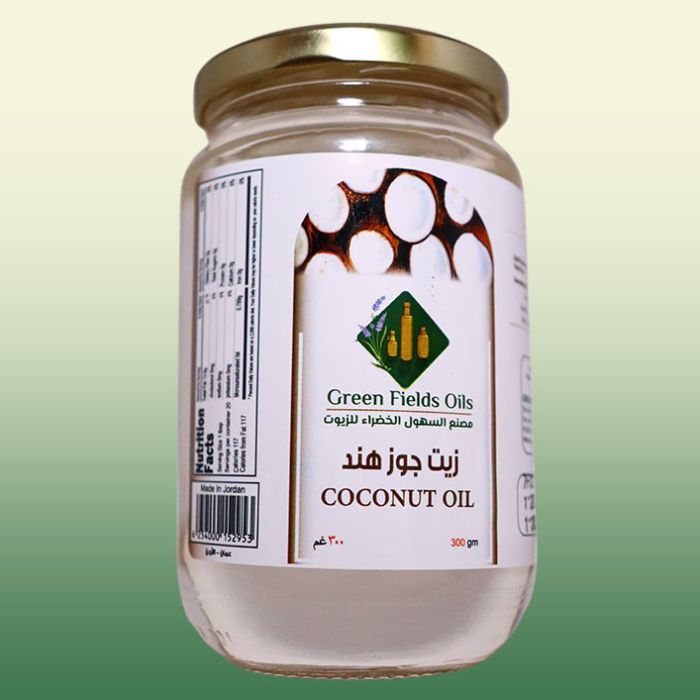
Coconut Oil
Cold-Pressed Coconut Oil
Pure coconut oil (Cocos nucifera), cold-pressed and packed in our facility in Amman. No heat, no solvents, no refining, no bleaching, no deodorising.
Virgin, not refined
Most coconut oil sold cheaply is RBD — refined, bleached and deodorised. That process strips out the aroma and flavour and produces a neutral white fat that could have come from anywhere.
Ours is unrefined. It smells and tastes of coconut, because that's what it is.
Solid or liquid, depending on the room
Coconut oil melts at around 24°C. In an Amman winter it will be firm and white; in summer it will be clear and liquid. Both are normal, and neither indicates a problem with the oil.
If you need it liquid, stand the jar in warm water for a few minutes. Don't microwave it.
In the kitchen
Unusually stable for a plant oil, because it is largely saturated fat — which means it handles heat far better than most of what we press.
- Frying and sautéing at medium heat
- Baking, in place of butter in many recipes
- In curries and South and Southeast Asian dishes, where it belongs
- Stirred into porridge, oatmeal or coffee
- In raw desserts and chocolate, where it sets firm when chilled
Note that the coconut flavour carries through into food. In a curry that's welcome; in a delicate cake it may not be.
On skin
One of the most widely used oils in the world for skin, and for good reason — it spreads easily, absorbs at a moderate pace, and leaves skin feeling soft.
Used as a body moisturiser, a massage oil, and for removing makeup. One caution: coconut oil is comedogenic for many people, meaning it can block pores. It suits the body far better than the face, and if you're prone to congestion, jojoba or safflower are better choices for facial use.
On hair
This is where coconut genuinely stands apart. Its main fatty acid, lauric acid, has a molecular structure that allows it to penetrate the hair shaft rather than simply coating it — something few oils do.
Massage into the lengths and ends before washing, leave for thirty minutes or longer, then shampoo out. It's one of the twelve oils in our Hair's Mix.
How it's made
Cold-pressed without heat or chemical solvents, then filtered and packed. Unrefined, non-GMO, hexane-free, vegan-friendly. Nothing added — no bleaching, no deodorising, no hydrogenation.
Produced in an ISO 22000 certified facility and tested by independent third parties. Halal certified. Available in retail jars, bulk, and private label.
Storage and notes
- Store at room temperature. Refrigeration isn't necessary; coconut is among the most stable oils and keeps well for a long time.
- Solidifying below 24°C is normal.
- Use a clean, dry spoon — water introduced into the jar shortens its life.
- Contains coconut. Avoid if you have a coconut allergy.
Latin Name: Cocos nucifera · INCI Name: Cocos Nucifera (Coconut) Oil
| SKU | 693 |
|---|---|
| Weight | 0.056000 kgs |
| Brand | Green Fields |
| Country of Manufacture | Jordan |
Coconut oil has been a treasured natural resource for thousands of years...
with its history deeply rooted in tropical regions like Southeast Asia, India, and the Pacific Islands. The coconut tree, often called the "Tree of Life," provided ancient communities with more than just oil... it offered food, shelter, tools, and even medicinal remedies.
Coconut oil was extracted from the meat of the nut, either through sun-drying or boiling methods, and became a cornerstone of health and beauty rituals.
In Ayurvedic medicine, coconut oil was revered for its healing properties, used to treat wounds, soothe skin conditions, and nourish hair.
Meanwhile, in Polynesian cultures, coconut oil was a beauty secret, applied to skin and hair to protect against the harsh sun and salty ocean air. Its antimicrobial and moisturizing qualities made it indispensable in maintaining healthy skin and hair long before modern cosmetics.
Today, coconut oil continues to shine in skincare, haircare, and wellness. Packed with medium-chain fatty acids like lauric acid, it deeply hydrates, protects against moisture loss, and even boasts antimicrobial benefits. Its growing popularity in natural beauty and wellness markets has only solidified its timeless reputation.
Fun Fact: During World War II, coconut oil was used as an emergency replacement for diesel fuel in the Philippines when petroleum supplies ran low! It proved so effective that it paved the way for biofuels derived from plant-based oils.
Validate your login