

Why Buy Direct from Green Fields Oils?
- We Are the Manufacturer – We cold-press every oil ourselves in our own facility. We are not a reseller.
- 20 Years of Experience – Family-owned and trusted since 2004.
- Certified Quality – ISO 22000, HACCP, and HALAL certified.
- Purely Made – 100% pure, with no additives, fillers, or solvents.
- Shipped from Jordan & UAE – Dispatched from Amman, Jordan, with regional support from our Ras Al Khaimah warehouse.
Why Buy Steam Distilled Oils from Green Fields?
- We Are the Distiller – Every oil is steam-distilled in our own facility. We are not a reseller.
- 100% Pure & Solvent-Free – No chemicals, no additives, no synthetic fragrance. Just the true essence of the plant.
- Over 20 Years of Experience – Family-owned and trusted since 2004.
- Certified Quality – ISO 22000, HACCP, and HALAL certified.
- Food-Grade Hydrosols Available – Safe for skincare, cooking, and wellness.
- Shipped from Jordan & UAE – Dispatched from Amman, Jordan, with regional support from our Ras Al Khaimah warehouse.
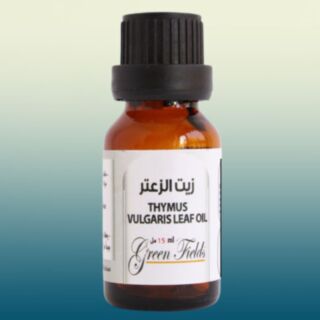
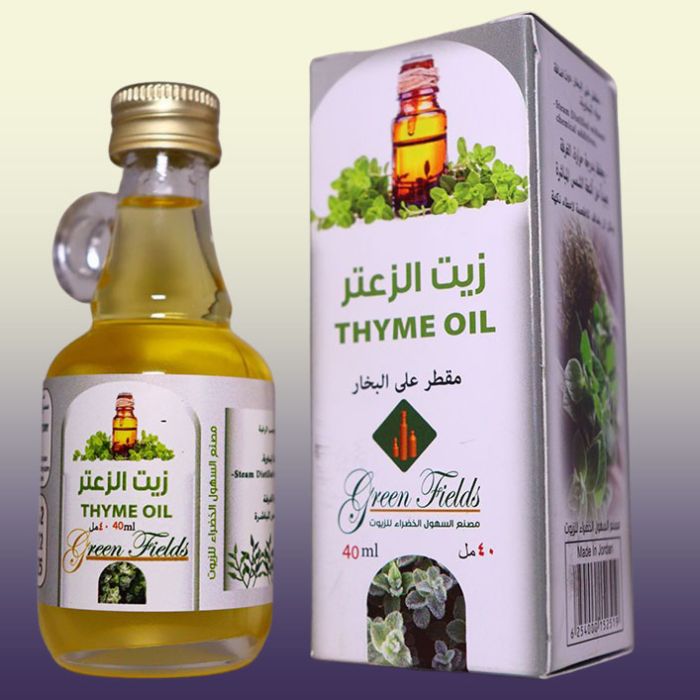
Thyme Ready-to-Use Oil — 3% Steam-Distilled in Sesame Oil
Thyme (Thymus vulgaris), steam-distilled in our own facility in Amman and blended at 3% into cold-pressed sesame oil. Food grade, and ready to use from the bottle.
Which thyme this actually is
A good deal of what is sold as thyme oil in this region is distilled from Origanum syriacum — the Levantine wild thyme used in zaatar, which is botanically an oregano. It’s cheaper, locally abundant, and the name is close enough that nobody questions it.
Ours is Thymus vulgaris, the small-leaved thyme of Syrian origin. A different plant with a different composition, and the one the name actually refers to.
Why pre-diluted
Pure thyme oil is too concentrated to use directly — on skin or in food. Most people who buy it dilute it themselves, guess at the ratio, and get it wrong in one direction or the other.
We blend ours to 3% before it reaches you. There is nothing to measure and no way to use it stronger than intended.
The base is our own sesame oil
Cold-pressed, unrefined, naturally containing vitamin E, sesamol and sesamin. Sesame is among the more stable plant oils, which is why it carries this whole line rather than a cheap refined base. It’s the same oil we sell on its own.
In the kitchen
Thyme oil is GRAS-listed by the US FDA as a food flavouring, and this blend is food grade. Used by the drop, as a flavouring — not taken as a supplement.
- A drop or two in a marinade for chicken or lamb
- Over roast potatoes or vegetables after cooking
- Into bread or focaccia dough
- In a dressing with lemon and olive oil
- Into soups and stews at the end of cooking
Start with one drop and taste. Thyme is far stronger than the dried herb.
What it’s like
Warm, sharp and distinctly herbaceous, from the thymol and carvacrol in the plant. Green and clean, with none of lavender’s softness or rosemary’s lift.
On skin and hair
Can be used in Creams and Oils. Massage into the scalp and lengths, leave for thirty minutes, then wash out. Also used in massage blends. Use it more sparingly than lavender or rosemary — thyme is strong even at 3%.
How it’s made
Steam-distilled in small batches in our facility in Amman — only steam touches the herb, with no solvents or chemicals. The distilled oil is blended into sesame oil we press ourselves in the same building. Nothing is added: no fragrance, no colour, no preservatives.
Produced in an ISO 22000 certified facility and tested by independent third parties. Halal certified. Available in retail bottles, bulk, and private label.
Please read before use
- Used as a flavouring in drops, or externally. Not taken as a supplement.
- Patch-test before applying to skin and wait 24 hours. Thyme irritates skin more readily than most oils.
- Keep away from eyes and mucous membranes.
- Contains sesame oil. Avoid if you have a sesame allergy.
- Store in a cool, dark place with the cap closed.
Latin Name: Thymus vulgaris · INCI Name: Thymus Vulgaris (Thyme) Oil, Sesamum Indicum (Sesame) Seed Oil
| SKU | 643-1 |
|---|---|
| Weight | 0.156000 kgs |
| Brand | Green Fields |
| Country of Manufacture | Jordan |
Validate your login