

Why Buy Direct from Green Fields Oils?
- We Are the Manufacturer – We cold-press every oil ourselves in our own facility. We are not a reseller.
- 20 Years of Experience – Family-owned and trusted since 2004.
- Certified Quality – ISO 22000, HACCP, and HALAL certified.
- Purely Made – 100% pure, with no additives, fillers, or solvents.
- Shipped from Jordan & UAE – Dispatched from Amman, Jordan, with regional support from our Ras Al Khaimah warehouse.
Why Buy Steam Distilled Oils from Green Fields?
- We Are the Distiller – Every oil is steam-distilled in our own facility. We are not a reseller.
- 100% Pure & Solvent-Free – No chemicals, no additives, no synthetic fragrance. Just the true essence of the plant.
- Over 20 Years of Experience – Family-owned and trusted since 2004.
- Certified Quality – ISO 22000, HACCP, and HALAL certified.
- Food-Grade Hydrosols Available – Safe for skincare, cooking, and wellness.
- Shipped from Jordan & UAE – Dispatched from Amman, Jordan, with regional support from our Ras Al Khaimah warehouse.
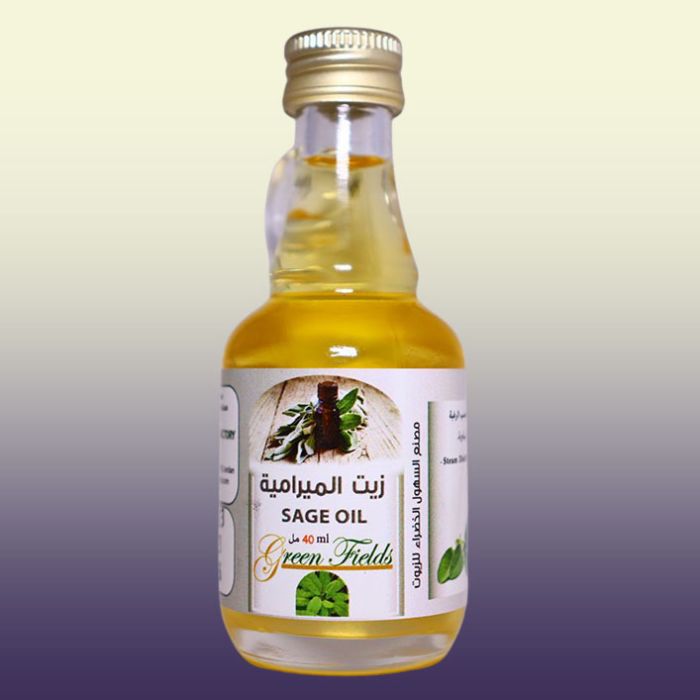
Sage Ready-to-Use Oil — 3% Steam-Distilled in Sesame Oil
Sage, steam-distilled in our own facility in Amman and blended at 3% into cold-pressed sesame oil. Ready to apply from the bottle.
Why pre-diluted
Pure essential oil is too concentrated for direct contact with skin. Most people who buy it dilute it themselves — buying a separate carrier oil, guessing at a ratio, and often getting it wrong in one direction or the other.
We blend it for you at 3%, the working strength for topical use. Nothing to measure, nothing to buy alongside it, and no way to apply it stronger than intended.
The base is our own sesame oil
Cold-pressed, unrefined, and naturally containing vitamin E, sesamol and sesamin. Sesame is one of the more stable plant oils, which is why we use it as the carrier across this line rather than a cheap refined base. It’s the same oil we sell on its own.
Because the blend is mostly carrier, the carrier is most of what you’re buying.
What it smells like
Deep, herbal and slightly camphorous — drier and more savoury than rosemary, and with none of lavender’s softness. Sage is a serious scent rather than a pleasant one, and people tend to know immediately whether they like it.
How to use it
Scalp and hair — Massage into the scalp and lengths, leave for thirty minutes or longer, then wash out with shampoo. Once or twice a week suits most people.
Massage — Ready to use on shoulders, back and legs, alone or combined with a lighter oil.
In your own blends — Combines readily with rosemary, lavender and the other oils in our ready-to-use line.
How it’s made
Steam-distilled in small batches in our facility in Amman — only steam touches the herb, with no solvents or chemicals. The distilled oil is blended into sesame oil we press ourselves in the same building.
Nothing is added afterwards. No fragrance, no colour, no preservatives.
Produced in an ISO 22000 certified facility and tested by independent third parties. Halal certified. Available in retail bottles, bulk, and private label.
Please read before use
- For external use only. Not to be taken internally.
- Not for use on children.
- Keep away from the eyes.
- Patch-test before wider use.
- Contains sesame oil. Avoid if you have a sesame allergy.
- Store in a cool, dark place with the cap closed.
Looking for something far gentler from the same distillation? Our sage hydrosol is the aromatic water that comes off the same run — undiluted, and light enough to mist straight onto skin.
| SKU | 638-1 |
|---|---|
| Weight | 0.156000 kgs |
| Brand | Green Fields |
| Country of Manufacture | Jordan |
What Makes Ours Different
It arrives ready to use
Most essential oil is sold pure, which means it cannot be used as it comes. You are expected to buy a carrier oil separately, work out a ratio, and dilute it yourself — and most people guess.
We blend ours to 3% before it reaches you. There is nothing to measure and no way to get it wrong.
The base is a real oil, not a filler
Diluted oils are usually cut with cheap refined carriers chosen for costing nothing and tasting of nothing. Ours is our own cold-pressed sesame — unrefined, naturally stable, and the same oil we sell on its own.
Since the blend is mostly carrier, that choice is most of the product.
A press and a still
We own both, which is unusual for a producer our size. Most companies have one or the other, and describe their products accordingly.
Having both means we choose the method that suits each material rather than the one we happen to own — the sage distilled, the sesame pressed, both in the same building, within a few metres of each other.
We say what we don’t know
Our sage comes from a Lebanese supplier. We have not yet confirmed the species by laboratory analysis, so we don’t print a botanical name on this page — unlike our thyme, which we can tell you is Thymus vulgaris rather than the cheaper substitution, or our spearmint, which is Mentha spicata and not peppermint.
When we have the analysis, it will go here. Until then, this is what we know.
Certified and documented
Produced in an ISO 22000 certified facility, tested by independent third parties, Halal certified. Batch documentation available to commercial buyers.
The Story of Sage
The herb named for saving
Sage’s botanical name comes from the Latin salvere — to save, to be well. The Romans named it for what they believed it did, and the name stuck through every language that borrowed it.
There is a medieval Latin line that survived into English: Cur moriatur homo cui salvia crescit in horto? — why should a man die who has sage growing in his garden? That is an overstatement, obviously. But it tells you how seriously this plant was taken.
In our part of the world
Here sage is مريمية, and the association is older than the Latin. The name connects the plant to the Virgin Mary, and the herb carries that quiet reverence across the Levant.
But mostly it is a drink. A pot of sage tea after a heavy meal, a few leaves added to black tea in winter, a glass offered to someone who is unwell. In Jordan, Palestine, Syria and Lebanon, sage is in the kitchen before it is anywhere else — one of the few herbs that is both everyday and slightly ceremonial.
It grows wild on these hillsides. Most people here can recognise it without being taught.
From the pot to the still
Sage tea extracts what dissolves in water. Steam distillation extracts something else: the volatile aromatic compounds, concentrated into a small quantity of oil. The same plant, a different half of it.
That distinction is old. Avicenna described steam distillation a thousand years ago, and sage was among the herbs the early distillers worked with. What has changed since is the equipment, not the principle.
The one thing worth knowing
Sage contains thujone — the compound behind both its strength and its cautions. It is why sage oil is used sparingly and externally, why it isn’t recommended in pregnancy, and why a herb this familiar still requires care in concentrated form.
That the plant is ordinary in a teapot and demanding in a bottle is not a contradiction. It is what concentration does.
Validate your login